
 Design Consultancy – Staff & Space Analysis
 Furniture & Accessories Specifications
 Sustainable Office Clearance
 Asset Audit and Tracking
We’ve all attended a hybrid meeting that didn’t flow as smoothly as expected. Twelve people seated around a long rectangular table, half of them in the room, several joining remotely. The agenda is important, the stakes are real, and somewhere in the middle of the call, the same thing that always happens, happens again: the remote participants drift.
They can't quite see who's speaking. The camera doesn't reach the far end of the table. The people closest to the screen dominate by proximity rather than contribution. By the time the meeting closes, those dialling in are observers of the conversation rather than participants in it.
The hybrid meeting room problem most offices still haven’t solved
It isn't just a technology problem. A better camera won't fix it, and a faster internet connection won't either. The problem actually lies in the geometry of a room and a table designed for an era when everyone was assumed to be in the same place at the same time.
Hybrid working is no longer a temporary adjustment; it's how organisations operate. Yet many boardrooms and collaborative meeting spaces are still built around the same assumptions they were twenty years ago: long, rectangular tables, fixed end-of-room screens, and a camera setup that serves the room rather than the meeting. Addressing this doesn't always mean a full refurbishment. More often, it starts with the table.
What makes the Steelcase Ocular™ Sightline table different?
Steelcase's Ocular™ Sightline collection was designed specifically for the hybrid meeting challenge — not retrofitted to it. The central insight is that if the table's geometry provides better sightlines, the meeting performs better. People can see each other. Cameras can read the room. Screens sit within natural eyelines rather than requiring awkward head turns.
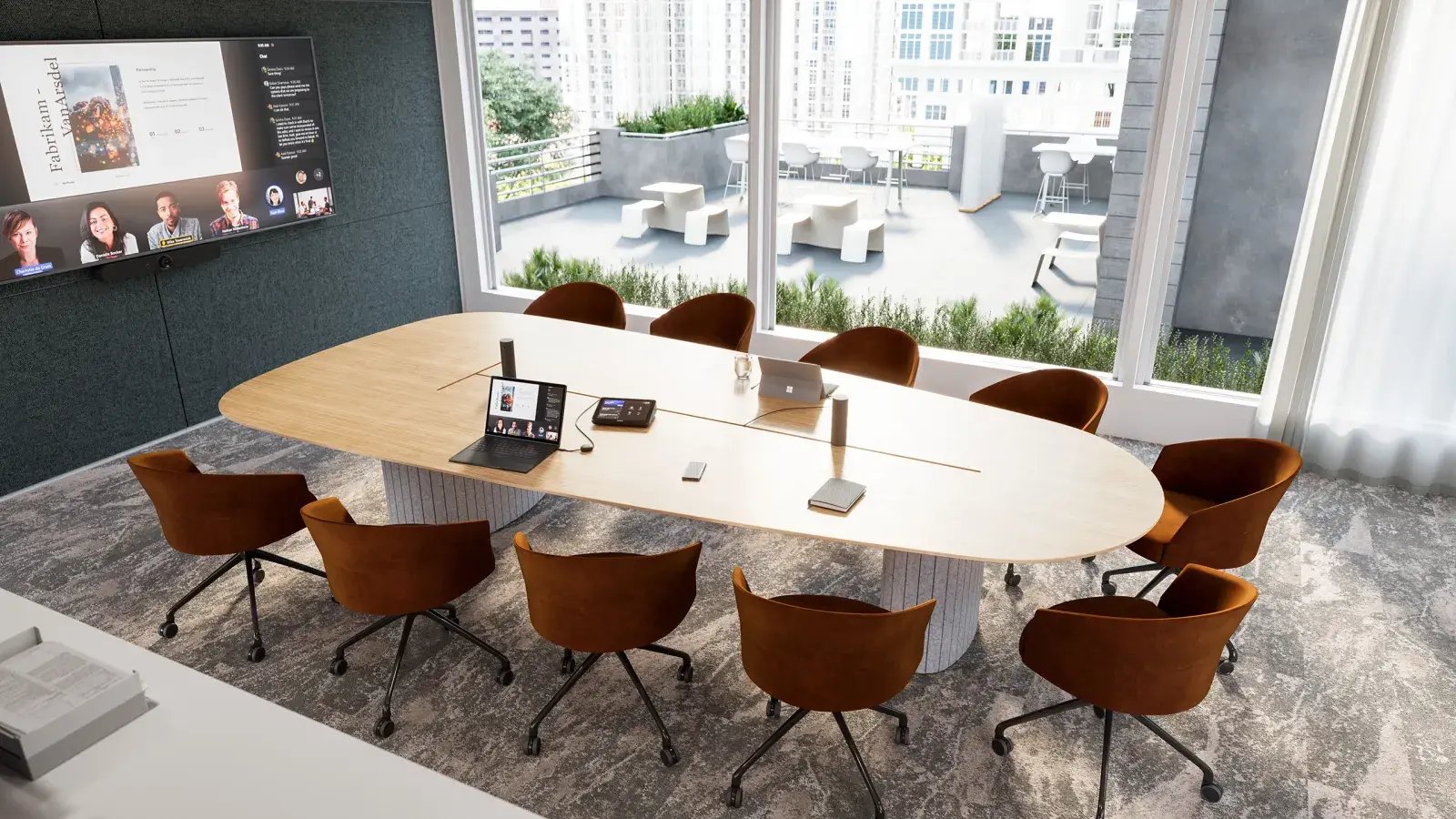
Steelcase Ocular Range | Sightline Conference Table
The Sightline table achieves this through its curved, elliptical form, which draws all participants — in-room and remote — into a more equitable visual relationship. There are no structurally dominant seats, no positions that are "bad for the camera," and no end-of-table dead zones where participants disappear from the frame.
The drum-style base removes the central leg obstruction common to larger rectangular tables, improving comfort and accessibility, and making cable routing and integrated power management considerably cleaner.
The commercial case is equally clear. Sightline delivers hybrid performance that previously required either custom AV integration or bespoke furniture design, at a price point that makes it realistic for corporate specification rather than flagship-only rollout. When the table does the heavy lifting on geometry, the broader technology stack can do what it's actually designed to do.
When a good product needs expert specification
Steelcase's standard Sightline range serves the six-, eight-, and ten-person meeting room well. But real organisations don't always work in standard configurations. A group legal function might regularly convene sixteen people. A cross-functional leadership team might need twelve seats in a room that also has to flex for external presentations. The hybrid performance benefits of Sightline are precisely what these larger, more complex meetings need, but the standard brief won't get them there without expert input.
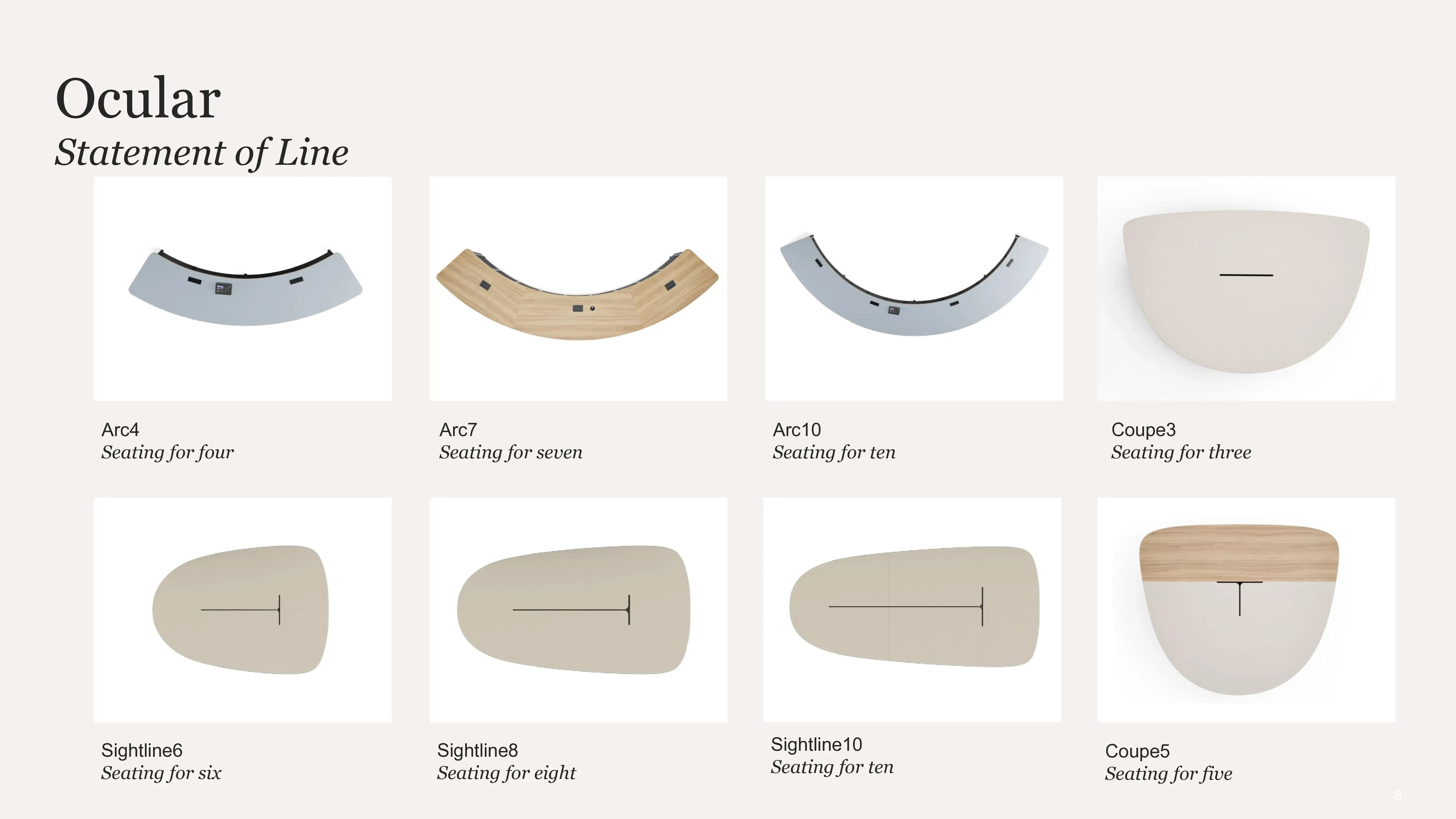
Steelcase Ocular range | 3-, 4-, 5-, 6-, 7- 8-, & 10-seaters
This is where IE's role as a furniture specification and design partner adds genuine value. In several recent client projects, IE has extended Sightline thinking to larger, more complex hybrid meeting environments, working beyond the brochure to build solutions that preserve the design intent of the collection while accommodating the real constraints of the room: its dimensions, its camera position, its circulation requirements, its technology layout, and the behaviours of the people who'll use it.
IE's approach is collaborative by nature. Specification isn't completed in isolation but developed in close dialogue with clients, AV specialists, and design teams to ensure that every decision, from seat width to screen wall relationship, is made with the full picture in mind.
Bespoke specification is about performance, not customisation for its own sake
It’s important to note that specifying a 12- or 16-person Sightline application isn't simply a matter of scaling the table up. It's about understanding what makes the table perform well and ensuring performance isn't compromised by its size. A larger table in the wrong orientation, or with the wrong relationship to the room's camera position, can undermine the very sightlines the product was designed to protect.
IE's specification process for hybrid meeting tables considers the following:
- Screen wall location — where screens are positioned relative to participant sightlines
- Camera position — how the camera reads the table and whether all participants fall within its field of view
- Participant sightlines — IE works closely with the client's AV specialists to align furniture and technology decisions
- Seat count and seat widths — ensuring comfort and appropriate spacing, particularly for longer or more formal meetings
- Accessibility — compliance with relevant standards and practical usability for all participants
- Cable management and power — clean, integrated routing that avoids surface clutter and supports technology use throughout the meeting
- Comfort over longer sessions — ergonomic considerations that affect engagement and sustained attention
- Aesthetic alignment — ensuring the table reads as part of a coherent workplace environment, not an isolated purchase
IE draws on relationships with over 300 manufacturers and brings that breadth of market knowledge to every project, not to over-engineer a solution, but to ensure the right one. Commercial pragmatism sits alongside design quality, the goal being a result that performs, looks considered, and fits the programme and budget.
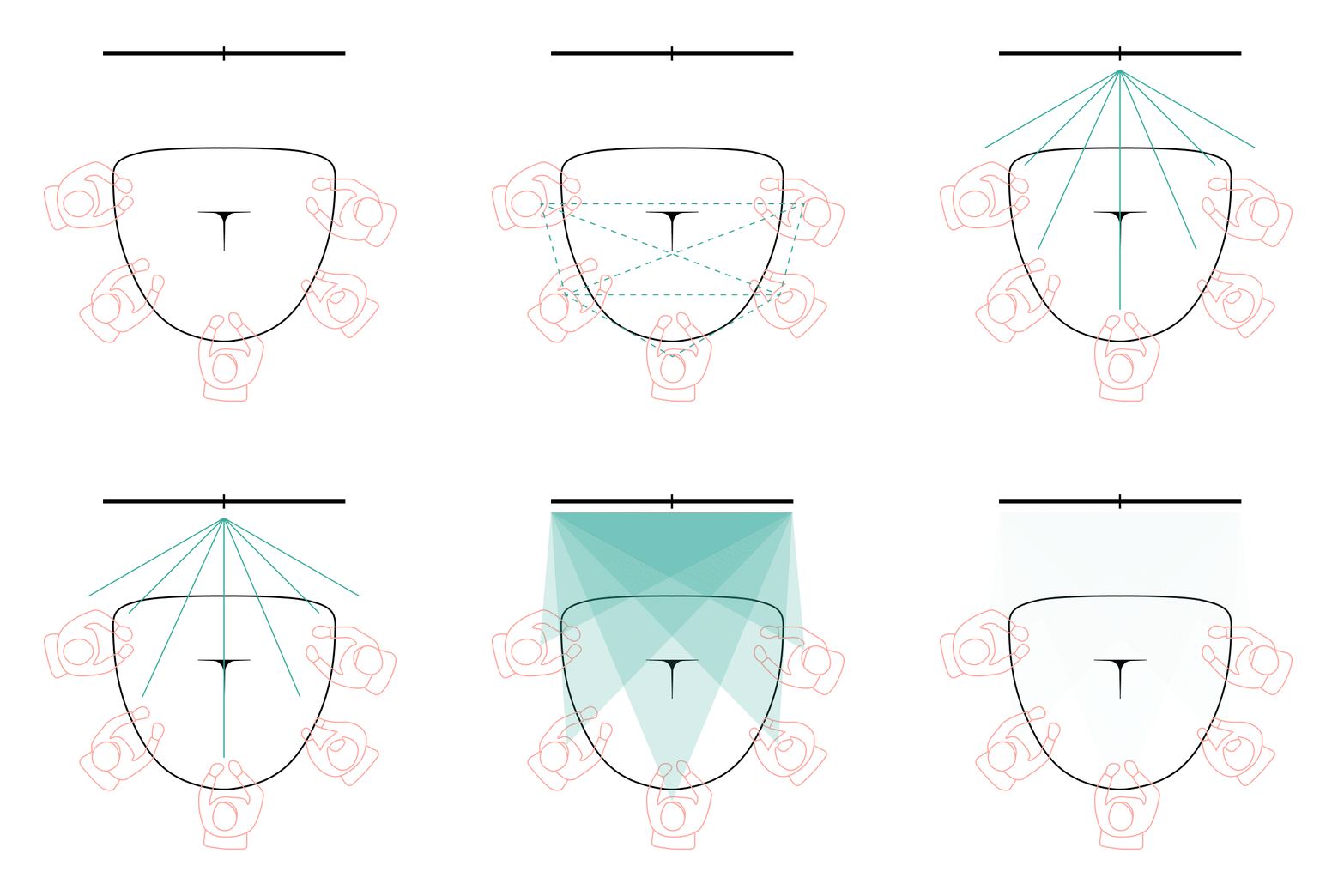
Key sightlines for virtual meetings: people-to-people, people-to-screens, people-to-cameras
A practical checklist for better hybrid meeting room performance
Whether you're specifying a new suite of meeting rooms or reviewing the performance of existing spaces, these questions provide a useful starting point:
- Can every in-room participant be clearly seen by the camera?
If there are seats that fall outside the camera's field of view, the table geometry is working against the meeting. - Can remote participants engage actively, not just observe?
Equity of presence matters — remote attendees should feel part of the room, not appended to it. - Does the table shape support natural eye contact with both colleagues and screens?
Turning away from the screen to address the room (or vice versa) erodes engagement over time. - Are there any "bad seats"?
A well-specified hybrid table shouldn't have positions that are consistently harder to use, harder to see from, or harder to be seen from. - Does the solution integrate cleanly with power, cable routing, and the room's technology ecosystem?
Surface clutter and exposed cabling undermine both aesthetics and function.
Sightline addresses many of these fundamentals by design. IE's value is in adapting that specification when your brief — room size, seat count, camera position, budget — requires something more considered.
Conclusion: The right table should also fit your wider workplace goals
Hybrid collaboration spaces deserve more than generic boardroom furniture. The best outcomes come when product intelligence is paired with expert specification, as choosing the right hybrid meeting table is one decision within a broader set. Responsible specification means thinking about lifecycle, fit-for-purpose performance, long-term cost, and the environmental footprint of the furniture itself, not just the finish and the lead time.
IE's Sustainable Office Furniture Solutions support clients who want furniture decisions that align with their environmental and social commitments, without compromising on design quality or commercial rigour. From specification and sourcing through to stewardship and end-of-life planning, IE helps organisations make choices they can stand behind both now and in the future.
If you're rethinking your meeting rooms, briefing new collaboration spaces, or need furniture that supports hybrid work more effectively, IE can help. Get in touch about IE's Office Furniture Solutions and let's talk about what your rooms need to help your people perform.