
 Design Consultancy – Staff & Space Analysis
 Furniture & Accessories Specifications

 Sustainable Office Clearance
 Asset Audit and Tracking
Every facilities and procurement team is now asked to buy "sustainable" furniture, yet not every sustainability claim on a spec sheet is telling the whole truth. Get it wrong, and a genuine attempt to do right by the planet can undermine your organisation's own ESG commitments, or leave you unable to answer a straightforward question in a tender.
This blog shows you how to tell a verified environmental claim from marketing gloss, and takes a closer look at three claims often used to signal sustainability, to see whether they hold up.
What is greenwashing, and why does it matter for furniture procurement?
Greenwashing is when a sustainability claim exaggerates or misrepresents a product's real environmental impact, and it is more common than most buyers assume. The European Commission examined environmental claims across sectors and found, alarmingly, that 53% were vague, misleading, or unfounded, and 40% had no supporting evidence at all.
For a procurement team, this matters beyond principle. Unverified claims can end up cited in a client-facing tender response or an ESG disclosure, where they may not be able to withstand scrutiny. They can also carry a cost: some suppliers charge a "green premium" of 15 to 25% for products with no independent certification behind the claim at all.
Five signs of a questionable sustainability claim
A claim is worth questioning if it shows any of the following:
- It cites a company-level standard as product proof. ISO 9001 and ISO 14001 certify a manufacturer's management systems, not the environmental performance of a specific product.
- It uses vague language with no named standard. "Eco-friendly" and "sustainably sourced" mean very little without a certification you can actually go look up.
- There is no certificate number. A genuine claim can be checked against a public register; a vague one usually cannot.
- A logo is applied across a whole range. Certification is typically awarded to a specific product, not automatically to every item a brand sells.
- A premium is charged with no evidence behind it. Price alone is never proof of impact.
What genuine proof looks like: certifications worth trusting
A small number of independently audited certifications cover most of what matters in furniture. The table below sets out what each one actually verifies.
| Certification | What it verifies |
| FSC Chain of Custody | Timber is traceable to a responsibly managed forest, without mixing with uncertified wood |
| GREENGUARD / GREENGUARD Gold | Low chemical emissions and VOCs, with Gold setting a stricter limit suitable for schools and healthcare settings |
| Cradle to Cradle | Material health, recyclability, water use, and social fairness across the product's lifecycle |
| Environmental Product Declaration (EPD) | A standardised, third-party-verified report of a product's lifecycle environmental impact |
| BIFMA Level | A tiered (1 to 3) sustainability standard specific to commercial furniture, covering materials, energy, and social responsibility |

When assessing the sustainability of a product, ask your supplier for the certificate number and check it yourself on the issuing body's public register (fsc.org, greenguard.ul.com, c2ccertified.org) before including a claim in a spec or tender response.
Gimmick or truly impactful?
Some materials are marketed as inherently sustainable when the reality is more mixed. Three examples, drawn from products available through our own supplier partners, illustrate where the story holds up and where it needs a closer look.
Ocean plastic: a good story, worth checking at the source
Most "ocean plastic" claims describe ocean-bound plastic collected from coastlines and rivers, not material recovered from the sea itself, because plastic fished directly from open water is usually too degraded to recycle into furniture-grade material.
That distinction matters because a credible claim should carry a named collection standard, such as OceanCycle or Zero Plastic Oceans certification, and disclose roughly how far from the water the material was collected.
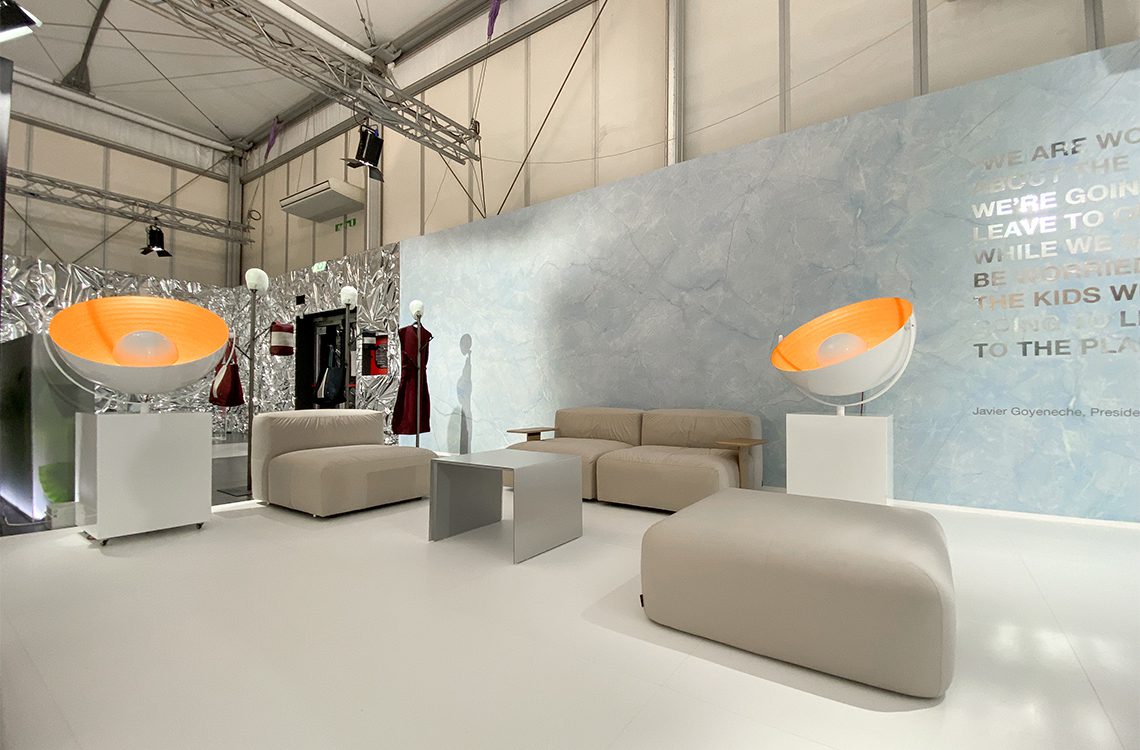
Viccarbe's Ecoalf edition Savina sofa is a useful illustration of the more honest version of this story. Rather than leaning on an "ocean plastic" label, its ECOPURE® foam core is made from 70% recycled content reclaimed from post-consumer mattresses and sofas, and its cover fabric is woven from recycled plastic bottles and corn-crop waste. It is a genuinely circular product, described in terms specific enough to check, rather than a broad claim that invites assumptions.
Carbon-neutral certification: verifiable, but understand what it measures
A carbon-neutral certification can be independently verified, but it does not reduce the emissions a buyer reports. Neutral, in this context, describes an offsetting outcome rather than a reduction in the resources used to make the product, so the product's full carbon footprint still belongs in the buyer's own carbon inventory.
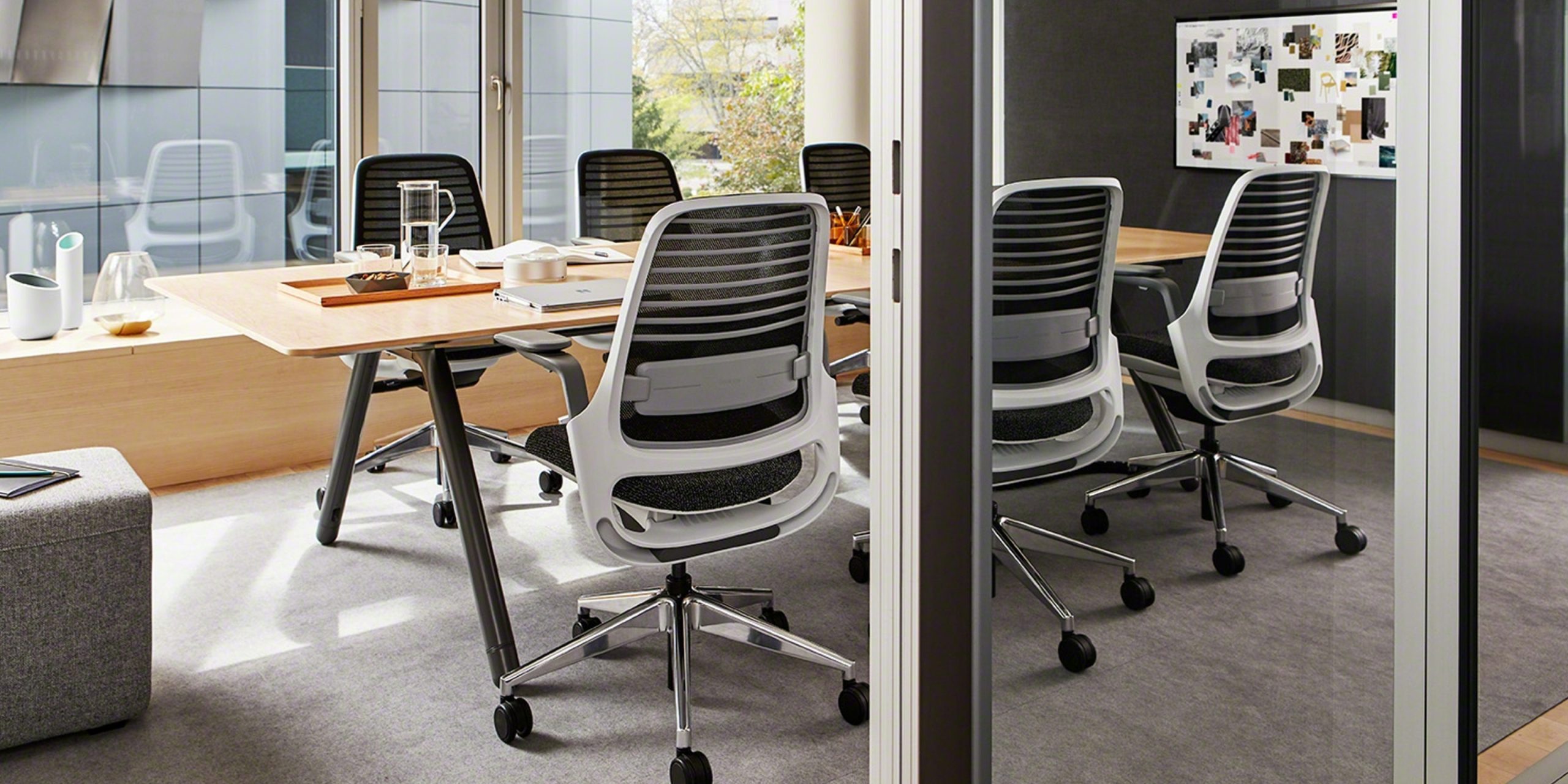
Steelcase's Series 1 with CarbonNeutral® certification is a case in point. The chair's cradle-to-gate carbon footprint, covering emissions from raw materials through to the point the chair leaves the factory, is 124.4kg CO2e. Those emissions are measured and verified by a third party, and Steelcase then compensates for them in full by funding Climate Impact Partners projects such as forest conservation, renewable energy, and efficient cookstoves.
For organisations that report their carbon emissions, this distinction matters. Purchased furniture sits within Scope 3, Category 1 of the GHG Protocol, and carbon credits cannot be deducted from that inventory. In practice, that means:
-
Record the chair's full footprint (124.4kg CO2e per chair) in your Scope 3 inventory.
-
Disclose separately, in a note alongside the report, that those emissions have been offset through the CarbonNeutral® programme.
Carbon-neutral certification is still a credible and transparent choice, and the separate disclosure can add useful context to an ESG report. It works alongside, rather than instead of, genuine reduction strategies such as furniture re-use, which avoids the emissions of a new purchase in the first place.
FSC-certified wood: simple and one of the easier claims to verify
FSC Chain of Custody certification is one of the most straightforward sustainability claims to check, because a certificate number can be searched directly on fsc.org against the specific product.
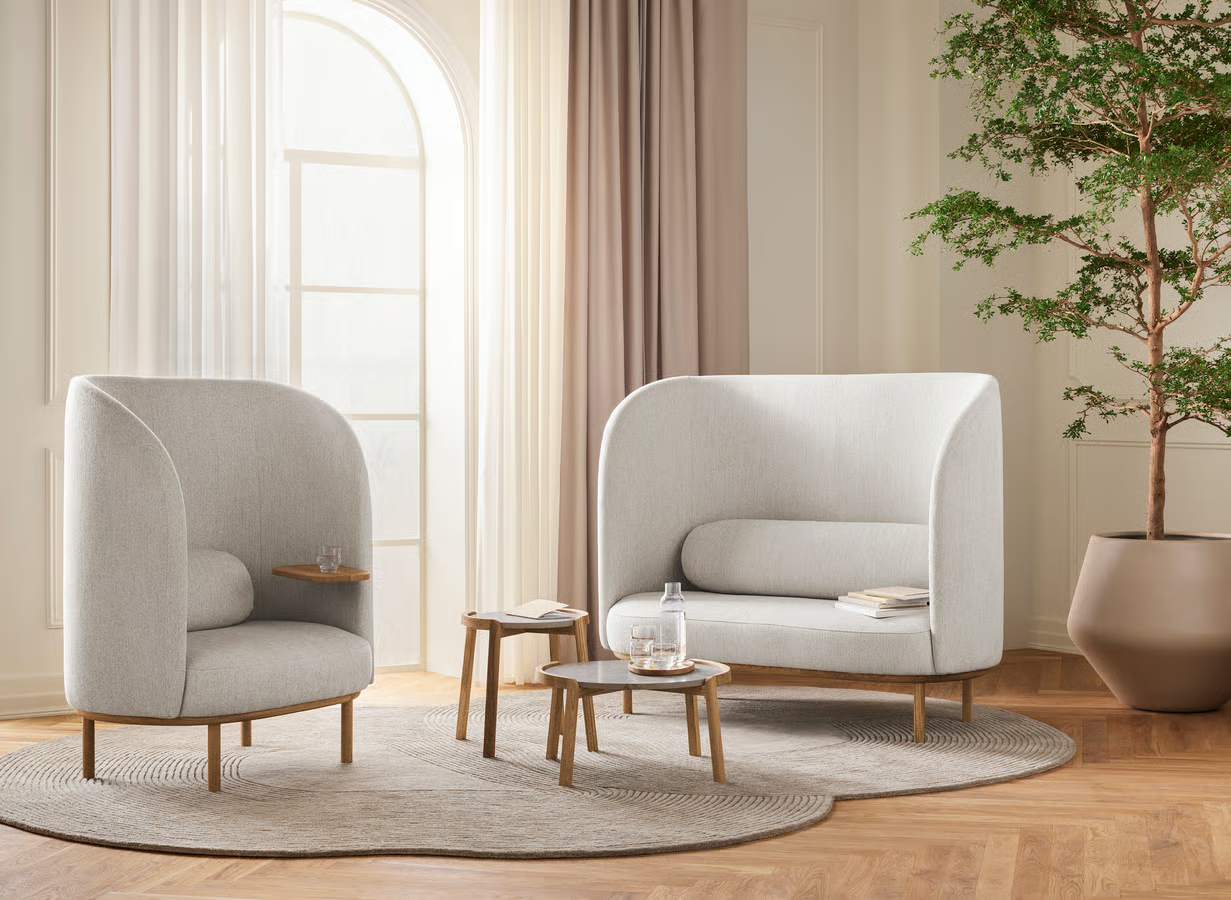
Bolia's Fuuga armchair, available through IE, is certified this way, meaning its timber can be traced through an unbroken chain back to a responsibly managed forest. It is not a headline-grabbing material story, but it is a claim that survives scrutiny.
Five questions to ask before you believe a sustainability claim
-
Does the certificate name the specific product, not just the company?
-
Can you look the certificate number up on the issuing body's public register?
-
Does the claim describe a genuine reduction, or an offset or accounting outcome?
-
Is recycled or "ocean" content backed by a named collection standard?
-
Would the claim still hold up if you read it out loud to your own ESG team?
Conclusion: Buying with confidence
Genuinely sustainable furniture does exist, and it can usually prove itself. A claim worth trusting is one that survives you asking for the certificate number, the standard it sits against, and the specific product it covers. As a certified B Corporation, we at IE hold our own claims to the same standard we'd ask of a supplier.
If you're specifying furniture and want help separating verified credentials from marketing speaking, talk to IE's expert team about a sustainable furniture specification, or explore our range of sustainable office furniture solutions.