
 Design Consultancy – Staff & Space Analysis
 Furniture & Accessories Specifications
 Sustainable Office Clearance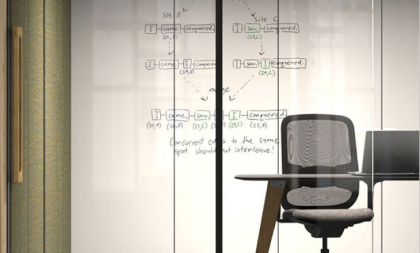
 Asset Audit and Tracking
More organisations now want their workplace to reflect their sustainability ambitions, whether that's a net-zero target, an ESG disclosure requirement, or simply a genuine commitment to doing right by the planet.
Furniture rarely gets treated as part of that conversation. It's seen as a design decision, or a budget line, rather than a carbon one. But every piece of office furniture you specify carries a carbon cost, and it's fixed the moment the order goes through. Unlike energy use or waste, there's no fixing it after the fact, which is why it's worth understanding before making procurement decisions for your workplace project.
What is embodied carbon?
Embodied carbon is the greenhouse gas emitted across a product's entire lifecycle, from extracting raw materials through to manufacturing, transport, and disposal.
For a desk or chair, embodied carbon is made up of:
- Raw materials: extracting and processing inputs like steel, aluminium, or timber
- Manufacturing: the factory energy and processes used to make the product
- Transport: moving components and finished products to site
- End of life: what happens once the product is no longer in use, including disposal or recycling
It’s sometimes called "upfront carbon" because a large share of it is released before the product ever reaches an office. Once a chair has been manufactured and shipped, that carbon has already been spent. Nothing that happens afterwards can claw it back.
%20(1).jpg?width=800&height=450&name=26-0269523%20(2)%20(1).jpg)
How is embodied carbon different from operational carbon?
Operational carbon is the emissions produced while a building is in use, such as heating, cooling, lighting, and powering equipment. Embodied carbon is the emissions produced in making the things inside it, including the furniture.
Unlike a building, furniture itself has no operational phase, since it doesn't consume energy once it's in place.
|
Embodied carbon |
Operational carbon |
|
|
When it's released |
Upfront, during manufacture, transport, and disposal |
Continuously, throughout the product or building's life |
|
Can it be reduced later? |
No. It's fixed at the point of purchase |
Yes. Through more efficient use, better energy tariffs, or retrofits |
|
Who controls it |
The buyer, at the specification stage |
Facilities and operations teams, on an ongoing basis |
|
Typical ESG reporting category |
Scope 3, Category 1 (purchased goods and services) |
Scope 1 and 2, largely |
A workplace's total footprint is roughly the sum of the two. Buildings and energy grids are getting more efficient, so the operational share keeps shrinking. Embodied carbon hasn't decarbonised at the same pace, so it now accounts for a growing share of the total.
We've seen this play out in construction. As buildings got cheaper to run, embodied carbon in materials like concrete and steel became a specification priority in its own right. Furniture is facing the same shift, but on a shorter cycle. A building's embodied carbon is fixed once, at construction, while furniture is replaced every five to ten years, so that same carbon cost is paid again at every refresh.
Why embodied carbon matters more for furniture than you might think
A building's structure carries its embodied carbon once, spread across decades. Furniture doesn't get that benefit. It's replaced far more often, so that embodied carbon gets repeated each time. A workplace that goes through three furniture refreshes over the life of a building has effectively tripled the embodied carbon associated with furnishing that space.
Purchased furniture falls under Scope 3, Category 1 of the GHG Protocol. Scope 3 typically accounts for the bulk of an organisation's total emissions, and most of it is hard to influence directly, since it depends on choices made elsewhere in a supplier's own operations. Furniture is one of the exceptions. What gets specified is a decision buyers make directly. That makes it one of the more accessible levers for a facilities or procurement team to achieve genuine Scope 3 reduction.
If sustainability and ESG targets are part of your workplace brief, embodied carbon deserves a place alongside budget and design from the start.
.jpg?width=800&height=450&name=26-0269527%20(1).jpg)
What to ask suppliers for
Vague claims like "eco-friendly" or "sustainable" aren't enough to base a procurement decision on. During tendering, it's worth asking for three specific things:
Environmental Product Declarations (EPDs)
An EPD is an independently verified document reporting a product's environmental impact against a recognised set of Product Category Rules. Not every product on the market has one yet, and coverage varies by manufacturer and category, but where one exists, it should give you a figure in kilograms of CO2 equivalent (kg CO2e) per product.
Cradle-to-grave lifecycle assessments
Cradle-to-grave is the methodology behind a credible EPD, covering the full life of a product from raw material extraction through to disposal or recycling, rather than stopping at the factory gate. Ask which scope a supplier's figures are based on, because a partial, cradle-to-gate assessment can make a product look better than a full cradle-to-grave figure would.
Buy-back and circularity commitments
Some manufacturers guarantee to remanufacture, refurbish, or recycle furniture once it reaches the end of its working life. For example, through buy-back schemes. This is worth agreeing at the point of purchase, since it's far easier to secure before a contract is signed than after.
The same thinking applies to what you already own. Reusing, refurbishing, or redeploying existing furniture avoids the embodied carbon of a replacement altogether, since there's no new product being manufactured to measure.
At IE, we've helped many organisations get value from their existing furniture. For Barclays' campus in Glasgow, an existing portfolio assessment found homes for over 10,000 items through resale, donation, and recycling, raising £80,000 for local charities. And a 3-site clearance project returned an £86,000 buy-back payment on furniture that would otherwise have gone to landfill. If you're interested in seeing whether there's hidden value in your own existing furniture, a furniture audit is a good place to start.
Design choices that reduce embodied carbon: examples from Steelcase
Two examples from Steelcase help make the ideas above more concrete. One shows what a genuine EPD figure looks like, while the other shows how a design choice can avoid repeating it altogether.
Steelcase Series 1 has a published EPD showing a cradle-to-grave figure of 70.8 kg CO2e per chair over a 10-year service life.
.jpg?width=800&height=450&name=22-0178943-scaled%20(1).jpg)
Steelcase Migration SE uses a modular build that can be updated and reconfigured for different functions over time, rather than replaced. This is the specification-stage decision from earlier in practice: a desk that doesn't need replacing doesn't repeat its embodied carbon, whatever that figure happens to be.
.jpg?width=800&height=450&name=22-0184129-scaled%20(2).jpg)
Read more on carbon-neutral chairs, or talk to our furniture solutions team about specifying against criteria like these from the outset. If circularity is a starting principle for your project, our blog post on circular design is worth a read.
Key takeaways
Embodied carbon should be considered early on in your workplace transformation project. Think about it alongside budget and design, before supplier conversations begin. Ask suppliers whether EPDs exist for the furniture they're specifying, and what scope those figures cover. Consider buy-back and circularity commitments at the point of purchase rather than leaving them until the end of life.
It may also be worth getting a furniture audit to establish what can be retained or redeployed before any new items are specified. Furniture that can be retained, refurbished, or redeployed avoids the embodied carbon of a replacement altogether, since that carbon was already spent when the item was first made. This is usually the strongest starting point of all.
For a wider look at sustainable furniture procurement, download the sustainable office guide. Or get in touch to talk to us about furniture options to meet your sustainability and budget requirements.