
 Design Consultancy – Staff & Space Analysis
 Furniture & Accessories Specifications
 Sustainable Office Clearance
 Asset Audit and Tracking
Soft retirement, also called “phased” or “flexible” retirement, describes the growing trend of employees tapering work gradually rather than stopping abruptly. This is not a fringe trend. It is becoming the default career trajectory for a large and growing portion of the UK workforce, and it carries significant implications for how offices are planned, furnished, and managed.
For UK workplaces, this means designing for a broader age range: quieter focus spaces, step-free access, ergonomic flexibility, and hybrid-ready booths that support experienced workers staying longer, on their own terms.
Three forces driving the soft retirement trend in the UK
Three factors are driving soft retirement in the UK: rising longevity alongside a later state pension age, cost-of-living pressure, and persistent skills shortages.
Longevity and later state pension age
The UK state pension age reached 66 in 2020 and is legislated to rise to 67 between 2026 and 2028, and 68 between 2044 and 2046. Many employees simply cannot afford full retirement at the traditional milestone, while others remain in excellent health and wish to continue contributing.
The employment rate among 50–64-year-olds now sits at approximately 71%, compared with 57% in 1992. For FM and HR teams, this data point is a mandate to make the office physically and cognitively accessible to a workforce that spans four decades of age range.
Cost-of-living pressure and financial resilience
A significant proportion of over-50s who had previously considered early retirement have reversed that decision in response to rising household costs. Many are returning to work, accepting part-time or consultancy arrangements — a phenomenon sometimes called "unretirement." This creates demand for flexible booking, hot-desking protocols designed around reduced hours, and private spaces for the sensitive financial and HR conversations that accompany re-entry or schedule negotiation.
Skills shortages and institutional knowledge
The UK faces structural skills gaps across engineering, healthcare, finance, and professional services. Retaining experienced workers — even at reduced capacity — preserves mentoring capability and institutional memory that takes years to rebuild. The Centre for Ageing Better states that one in three UK workers is aged 50 or over. For workplace strategy, this means designing spaces that support mentoring, knowledge transfer, and collaborative working across generations, not just individual heads-down focus.
Five practical ways to design for a multigenerational workforce
The best age-inclusive offices are not designed exclusively for older workers but for human variability. Below are five design principles that serve everyone, with particular benefit for those in the later stages of their careers.
1. Access and ergonomics: Removing physical barriers
Workplaces should comply with BS 8300:2018 (accessibility of buildings) and the spirit of the Equality Act 2010, which requires reasonable adjustments for age-related conditions. Furthermore, HSE DSE (Display Screen Equipment) guidance recommends regular workstation assessments, which should be extended to shared spaces and pods, as well as to fixed desks.
In practice, this means specifying step-free thresholds on all booths and pods, selecting chairs with a seat-height range of 400–520mm and armrests that flip away, ensuring that signage uses high-contrast text, and avoiding low-level controls that require crouching. Sit-stand desks and monitor arms reduce static posture risk for all users.
2. Acoustic privacy and focus: Supporting concentrated work
Cognitive performance is sensitive to distraction, and this sensitivity increases with age. Private, quiet spaces reduce the cognitive burden on all users and are especially valuable for those managing complex knowledge tasks or sensitive conversations.
Acoustic booths and enclosed pods significantly reduce background noise. Where published acoustic ratings are available, look for Rw ≥ 30dB for single-occupancy focus work. Paired with sound-masking in the wider floor plate, enclosed pods can further reduce perceived noise, supporting prolonged periods of focus work or private meetings and calls.
3. Intuitive technology and hybrid readiness
Many phased retirees work compressed or part-time schedules and rely on video calls to stay connected with teams. Pods and booths should offer integrated USB-C power, HDMI or wireless screen-sharing, and integrated cameras or monitor mounts. Controls should be large, clearly labelled, and operable without fine motor precision; consider using rocker switches rather than touchscreens where possible.
4. Wellbeing and quiet recovery
Biophilic elements like plants, natural light, and views to the outside are associated with reduced stress and improved concentration. Positioning workstations and booths near windows, incorporating living walls, and specifying warm-spectrum LED lighting (2,700–3,000K for recovery zones, 4,000K for task areas) supports circadian rhythm and reduces eye strain.
Recovery spaces with soft seating alcoves, or informal booths away from circulating traffic, give not just older workers but all workers a place to decompress between demanding meetings.
5. Choice and autonomy: Giving people control
Research consistently shows that autonomy is among the strongest predictors of job satisfaction and retention. For phased retirees, choice over where and how they work is often non-negotiable.
Offer a range of settings for the various work styles and approaches workers engage in on a typical day: open collaboration areas, enclosed focus booths, semi-private meeting pods, and casual lounge spaces. Enable easy self-selection through clear visual zoning and legible wayfinding.
Choosing acoustic pods and booths for a multigenerational office
The most useful pods and booths for an age-inclusive office fall into three broad categories: single-occupancy focus and call booths, small collaboration booths for two to four people, and larger enclosed meeting pods. Several manufacturers make well-regarded options in each category, and the right choice depends on your space, your budget, and how your people actually work.
Modular acoustic pods and booths slot into existing office environments without structural alteration. Most ship as self-contained units with integrated ventilation, lighting, and power, which makes them well-suited to the phased, pilot-led approach that many businesses favour. Because they are demountable, they can also be relocated as floor layouts change.
Single-occupancy focus and call booths
A single-occupancy booth gives one person an enclosed, acoustically treated space for confidential calls and concentrated work.
Phased retirement discussions, occupational health reviews, and flexible-working negotiations all call for a private, professional setting, and a solo booth provides that without having to book a formal meeting room. For older workers managing complex, high-value tasks, an enclosed booth also reduces ambient noise and supports concentration. Where a booth offers a step-free threshold, it removes a trip risk for users with mobility aids or reduced agility, a straightforward adjustment that signals an inclusive culture.
Examples across the market include Silen's Chatbox Single, a compact solo phone booth rated at around 34dB of noise reduction and Spacestor's Portals Quiet. When comparing options, look for a low or step-free threshold, large and clearly labelled controls, and integrated power and ventilation.
Small collaboration booths for two to four people
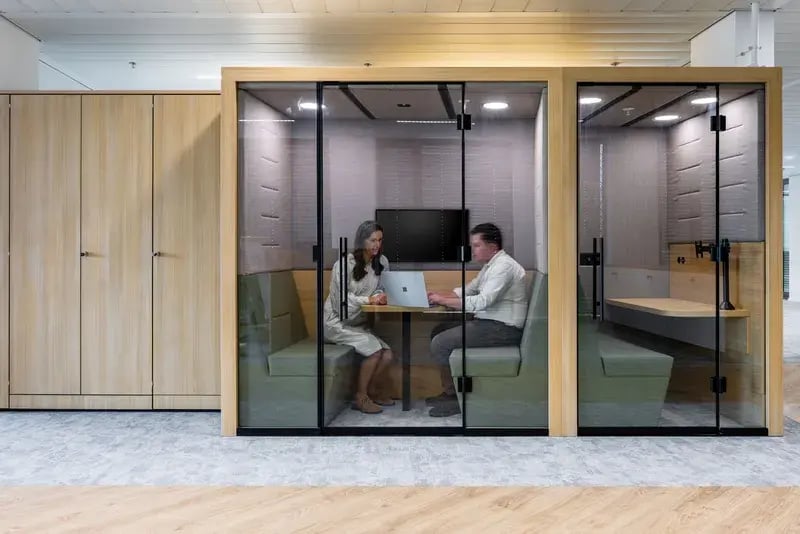
A small collaboration booth suits two to four people for face-to-face meetings and video calls.
This is the right setting for the structured knowledge-transfer sessions that make phased retirement arrangements genuinely valuable to an organisation. Glazed door options maintain a visual connection with the wider office, which can reduce the sense of isolation that some workers associate with enclosed spaces, while still providing acoustic privacy.
Options include Spacestor's Portals Huddle; Orangebox's Air³, which comes in a range of sizes and is designed to be DDA and Equality Act compliant; and meeting-sized pods from Silen's Space range.
Larger enclosed meeting pods
A larger enclosed pod accommodates roughly four to six people for private collaboration.
More adaptable than a traditional meeting room, a larger pod typically offers integrated power and charging, user-adjustable lighting and ventilation, a table, and a screen. It is especially useful for bringing senior knowledge holders and junior talent together in a focused, well-equipped space that accelerates skills transfer and relationship-building.
Options include Spacestor's Portals Room, larger configurations of Orangebox's Air³, and larger pods from Silen.
-jpg.jpeg?width=2712&height=1526&name=Orangebox-Air3%20(1)-jpg.jpeg)
A well-planned office often mixes brands, choosing each product on its merits for size, acoustic rating, accessibility features, and finish. An independent, multi-brand partner like IE can specify the best option for each setting rather than fitting your needs around one catalogue.
Seamless implementation with IE
At IE, we don’t just supply pods and booths. We manage the full process, from workplace audits, space utilisation analysis, configuration recommendation, trials and showroom visits, project-managed installation, and post-installation aftercare.
As an independent, multi-brand partner sourcing from a network of more than 300 manufacturers, IE can integrate acoustic pods and booths alongside ergonomic task seating, sit-stand benching, biophilic elements, and wayfinding solutions. The result is a coherent, multigenerational environment rather than a collection of disconnected products, and a specification driven by what suits your people and your space rather than a single supplier's range.
Next steps with IE
Organisations that invest in age-inclusive design stand to benefit materially. Providing a continuum of spaces, from fully open to fully enclosed, gives phased retirees and all employees genuine choice over their working environment, which supports the autonomy that drives engagement, knowledge-sharing, and retention.
IE works with FM and HR leaders to audit existing workplaces, develop multigenerational design strategies, and specify, supply, and install furniture solutions that perform over the long term. Whether you are planning a full refurbishment or piloting a single quiet zone, IE's consultative team can guide you from brief to completion and beyond.
Get in touch with our expert team to help you identify the right configuration for your workforce, your space, and your budget.

FAQs
1. What is soft retirement and how does it differ from traditional retirement?
Soft retirement (also called phased or flexible retirement) is when an employee gradually reduces their working hours or responsibilities over time, rather than stopping work abruptly. In the UK, it is increasingly common as the state pension age rises and cost-of-living pressures affect financial planning. It may involve a shift to part-time hours, a consultancy arrangement, or a reduced-responsibility role.
2. How should UK employers adapt their workplace design for phased retirees?
Key adaptations include: step-free access throughout the office and into all booths and pods; ergonomic seating with a wide height range; acoustic focus spaces for concentration and confidential conversations; intuitive AV and hybrid technology; and a variety of settings so employees can choose the environment that suits their needs on any given day.
3. What are acoustic pods and why are they useful for older workers?
Acoustic pods are self-contained, enclosed or semi-enclosed units placed within an open-plan office to provide a quieter, more private working environment without the need for structural partitioning. For older workers, and all employees, they reduce distracting background noise, support focus and confidential conversations, and can be equipped with hybrid video-call technology. Modular, relocatable options are available from a range of manufacturers, including Spacestor, Orangebox, and Silen.